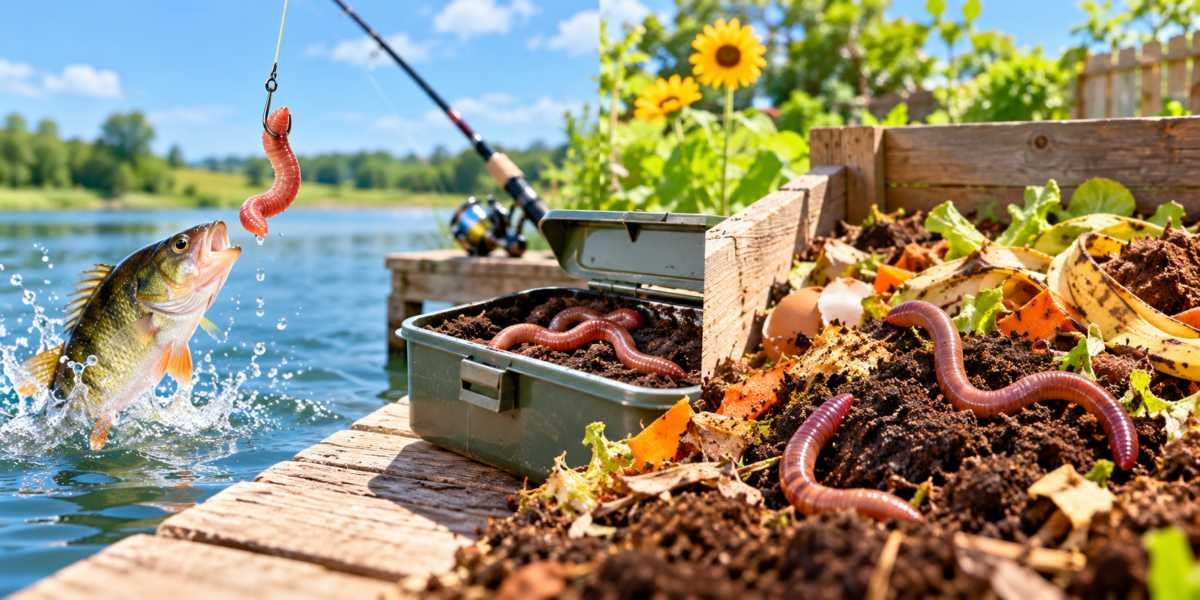
Dendrobaena worms, particularly Dendrobaena veneta, are widely associated with fishing because they combine several qualities anglers appreciate. They are reasonably large, lively, robust and capable of remaining active on a hook. Yet those same worms are also comfortable living among decaying organic material, which raises an interesting question: can a supply of fishing worms double as a working composting population?
The short answer is yes, although there are some important differences between keeping worms primarily for bait and operating a wormery primarily to process household organic waste.
Why Dendrobaena Make Such Useful Fishing Bait
Fishing bait has a fairly unforgiving job description. A worm must survive storage, tolerate handling, endure being placed on a hook and, ideally, continue moving enough to attract the attention of a fish. A worm that immediately becomes an unenthusiastic piece of string is considerably less useful.Dendrobaena are well suited to this role because they are relatively tough and active. Their size also makes them versatile. Larger specimens can be used whole, while smaller worms or sections can be presented when a less substantial bait is required. Depending on the fishing method and target species, they can be used alone or alongside other baits.
Their movement is particularly useful. Fish do not assess bait according to packaging, brand recognition or customer reviews. Movement, scent and natural appearance matter far more. A lively worm therefore arrives with its own advertising department built in.
Another advantage is that Dendrobaena can be kept for extended periods when provided with suitable conditions. Cool temperatures, adequate moisture, ventilation and appropriate bedding help maintain a healthy stock. That makes them practical for anglers who fish regularly and would rather maintain worms at home than repeatedly buy small quantities.
From Bait Box to Compost Bin
The qualities that make Dendrobaena convenient to keep also make them useful in worm composting. Unlike deep-burrowing earthworms that spend much of their lives further down in the soil, composting worms thrive where decomposing organic material is readily available.A wormery provides exactly that sort of environment. Kitchen scraps, partially decomposed plant material and other suitable biodegradable matter are gradually broken down with the assistance of worms and microorganisms. The resulting material can become a rich soil amendment, while the household simultaneously diverts some organic waste away from the general rubbish bin.
Dendrobaena will consume decaying organic matter and reproduce under favourable conditions. This means an angler can potentially maintain a living supply of bait while also gaining some of the benefits of vermicomposting. Yesterday’s vegetable peelings may therefore contribute, indirectly and after considerable worm-related administration, to next month’s fishing trip.
One Wormery With Two Purposes
The dual-purpose approach works best when the wormery is treated as a habitat rather than simply a container full of worms and leftovers. Moisture is particularly important. Bedding should generally remain damp without becoming waterlogged, because worms breathe through their skin and require moist conditions to function properly.Temperature matters too. Extreme heat, freezing conditions and prolonged exposure to direct sunlight can cause serious problems. Food should also be introduced sensibly rather than dumped into the wormery faster than the population can process it. A mountain of rotting scraps is not generosity. From a worm’s perspective, it is closer to receiving six months of paperwork on Friday afternoon.
Maintaining good conditions can therefore produce an appealing little cycle: household organic material feeds the worms, the worms help create useful compost, and selected worms can periodically leave the operation for a rather less promising career in angling.
Where Specialist Composting Worms Pull Ahead
Dendrobaena may be capable composters, but being good at two jobs does not necessarily make them the absolute champion of either. Wormeries designed primarily to process substantial quantities of organic waste often use species particularly well adapted to life in dense layers of decomposing material.Red wigglers, commonly associated with species such as Eisenia fetida, are especially popular for vermicomposting. They tend to reproduce readily under suitable conditions and are enthusiastic inhabitants of rich organic material. When the main objective is converting kitchen scraps into worm castings as efficiently as possible, specialist composting species can therefore have an advantage.
That distinction becomes more significant as the scale of the wormery increases. Someone maintaining a modest container while keeping a convenient supply of fishing bait may find Dendrobaena perfectly adequate. Someone attempting to process a steady stream of household organic waste may care much more about reproduction rates, population density and processing speed. At that point, the worm has ceased being bait with a useful sideline and has effectively joined the waste-management industry.
What Goes Into a Dual-Purpose Wormery
A successful wormery needs more than food. Bedding materials such as shredded cardboard, paper and partially decomposed organic matter help create the moist, aerated environment worms require. Kitchen waste can then be added gradually, ideally in relatively small pieces that microorganisms can begin breaking down readily.Suitable foods include many fruit and vegetable scraps, coffee grounds and other plant-based kitchen waste. Large quantities of acidic material should be approached cautiously, while meat, dairy products and oily cooked foods are generally poor choices for a simple domestic wormery. They can produce smells and attract unwanted visitors. The worms themselves are rarely responsible for a badly smelling wormery; poor conditions and excessive food are more usual suspects.
Overfeeding is particularly easy when starting out. A newly established worm population may process material much more slowly than expected. Adding another bucket of scraps because the previous bucket is still there applies a surprisingly common human management technique to worms, with similarly questionable results.
Harvesting Worms Without Wrecking the Population
Anyone keeping Dendrobaena for both purposes should avoid treating the wormery as an unlimited bait dispenser. Removing mature worms faster than the remaining population can reproduce will eventually leave plenty of compost and remarkably few employees.A healthier approach is to establish a thriving population before regularly taking worms for fishing. Maintaining suitable bedding, moisture, food and temperature gives the remaining worms the conditions needed to reproduce. Cocoons and juvenile worms should generally be left undisturbed where possible, allowing successive generations to develop.
It can also be useful to take only the number of worms genuinely required for a fishing session. Apart from protecting the breeding population, this reduces unnecessary handling and means the wormery continues performing its second job between trips.
Different Jobs Call for Different Worms
There is no requirement for a worm keeper to choose exclusively between bait production and composting. Dendrobaena occupy an interesting middle ground precisely because they can perform both roles. For an angler who also likes the idea of recycling some kitchen waste, their versatility is a considerable advantage.For dedicated vermicomposting, however, species selected primarily for rapid reproduction and vigorous processing of organic material may ultimately be more productive. Conversely, an angler is likely to place greater value on size, toughness, storage ability and movement on the hook than on how rapidly a worm can demolish yesterday’s cabbage leaves.
The best species therefore depends less on whether a worm can perform both jobs and more on which job matters most.
A Worm With a Very Full Diary
Dendrobaena demonstrate that fishing bait and composting livestock do not have to occupy completely separate worlds. With appropriate care, the same population can help process organic material, produce useful castings, reproduce and provide a renewable source of bait.They may not outperform specialist composting worms in every wormery, but that misses much of their appeal. Their strength lies in versatility. For anglers interested in reducing waste and maintaining their own bait supply, few creatures offer quite as much usefulness per handful of damp bedding. Not bad for an animal whose long-term career plan mostly consists of eating rubbish and trying not to meet a perch.
Article kindly provided by thewormhub.co.uk – dendrobaena worms